



Article written by Gary Saville.
Gary is a founding member of Goathland Nature. You can read more of his iNaturalist journal aticles on our Goathland Nature iNaturalist project page.
What has Bracken ever done for us?
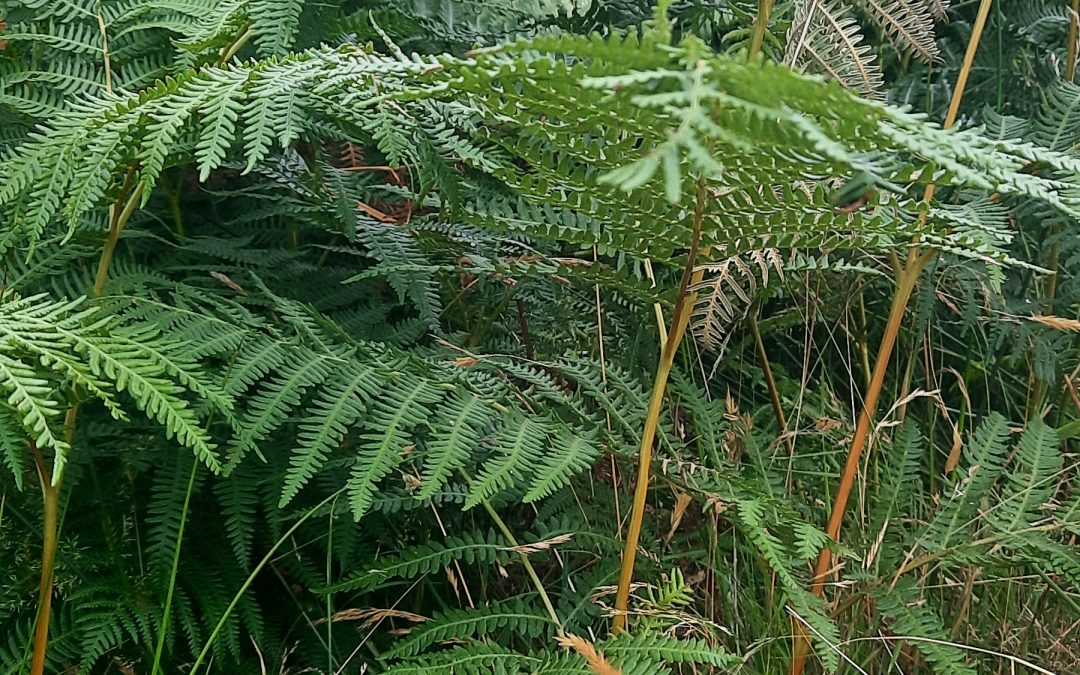
Coming back from holiday recently (August 2026) I noted a big change in the moors. Everything is brown – that is apart from the swathes of green bracken (Pteridium aquilinum) everywhere. I’m not keen on this monoculture (and neither are a lot of other people!), but it got me thinking about whether there are any benefits to it at all.
Bracken (Pteridium aquilinum) is one of the world’s most successful and ancient plants, with fossil records extending back over 55 million years. In the North York Moors National Park bracken covers about 20% of the moorland, increasing by 1% a year.
Downsides of bracken
Plenty of downsides are known about these vast bracken swathes:
-
- They tend to be highly species-poor and will rapidly replace the rich mosaic of grasses, bilberry and heathers on the moors.
- They adversely acidify and impoverish the soil for other plant growth and rain water run off will deteriorate and poison nearby water systems.
- Dead bracken dramatically increases the risk of upland wildfires.
- Bracken stands are a haven for ticks and other parasites that can infect livestock and humans alike.
- Bracken competes with good pasture and harms livestock, adding to farmers’ costs.
Ecological benefits of bracken
Whilst I haven’t seen a lot of wildlife in these bracken swathes, I have noticed that swallows feed over it in late summer presumably filling up on insects before their migration. There must also be other ecological benefits:
-
- Because they are so dense they offer ground-nesting birds such as the meadow pipit, willow warbler, yellowhammer and skylark useful nesting sites. Reptiles, such as common lizards and adders, also benefit from the dry carpet of dead bracken which creates a warmer microclimate for their thermoregulation.
- Specifically, the small pearl bordered fritillary butterflies have found a home amongst the bracken locally.
- There is a long history for bracken in folklore and mythology. It was used in folk medicines and more recently has been shown to contain chemicals which exhibit antioxidant, anti-inflammatory and antimicrobial properties.
- Traditionally, bracken has been used as an excellent bed litter for cattle and horses and after use, the bracken bedding, enriched with manure, was spread on fields as a fertiliser. Burnt bracken was a rich source of potash fertiliser, which is an essential nutrient for plant growth. Bracken was also cut and stacked for winter fuel. Unfortunately, in modern times there are many other alternatives for farmers, so the traditional practice of harvesting bracken has reduced, allowing bracken to spread more freely.
- One clear environmental benefit is bracken’s ability to stabilise the soil on steep slopes whilst also reducing water run off.
- Bracken can act as a nutrient pump redistributing phosphorus, potassium, nitrogen from their deep roots up to the topsoil.
- Another important environmental service provided by bracken is carbon sequestration. Because it shows vigorous growth, it captures carbon from the atmosphere, through photosynthesis, and stores it at a rate roughly equivalent to 290 tonnes of CO2 per hectare.
Bracken – good or bad?
So bracken is probably not all bad, nor completely biologically sterile. At the very least, it has a role in nutrient recycling, carbon storage and protecting soils from erosion. In a moor that has bracken intermixed with other plant species, the patches of bracken contribute shelter and microclimates on which some of our wildlife depends.
We probably don’t need to get rid of all of it, but rather work our a strategy to keep it under better control!
Gary